
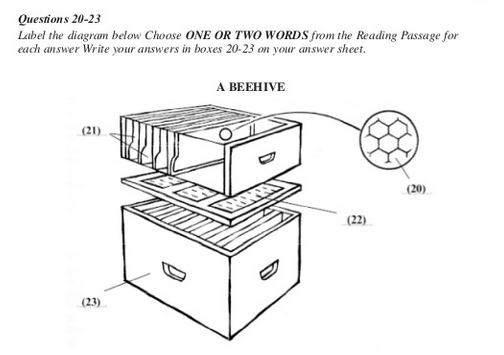
1. Dạng 1: giới hạn từ trả lời
2. Dạng 2: Không giới hạn số lượng từ trả lời
Vấn đề của thí sinh
Bí quyết làm bài
Chiến thuật làm bài
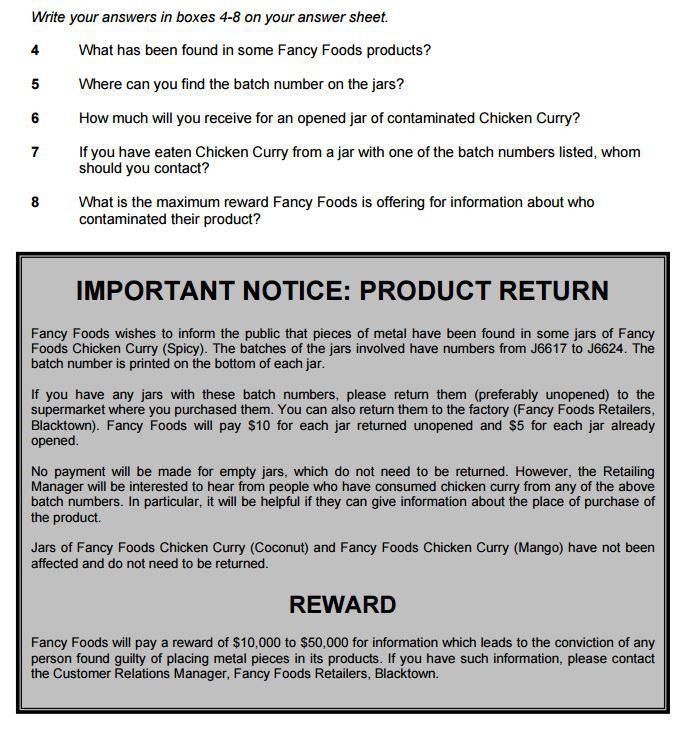
3. Example

Câu 4 – pieces of metal
Câu 5: on the bottom
Câu 6: 5$
Câu 7: the retailing manager
Câu 8: $ 50,000
4. Practice
Mini passage with questions.
North American meteorologists from the National Oceanic and Atmospheric Administration (NOAA)’s Hurricane Research Division have recently improved the success rate in their forecasting of where hurricanes are likely to hit land by an estimated 15 to 30%. This increase in accuracy is due to the use of instruments called GPS-dropwindsondes, which can probe the atmosphere surrounding a hurricane while it is still out at sea. The atmospheric characteristics of hurricanes over land are well understood because investigation is possible with weather balloons containing sophisticated meteorological instruments. When hurricanes are out of reach of balloons, gathering information is decidedly more difficult. Little is known of the weather conditions that guide hurricanes towards land.
An accurate estimation of where a hurricane will strike is essential in order to reduce loss of life and property. Hurricane Andrew, the most costly hurricane in U.S. history, killed 15 people and caused damage of $35 billion, in today’s dollars, in 1992. However, the unnamed : Category 4 2 hurricane which struck southeast Florida in 1926 and killed 243 people would have caused an estimated $77 billion if it had struck today. The reason for this is the explosion in population growth and development along the south-east coast of the U.S. during the last half century.
Hurricanes occur in cycles every few decades, the last intense period in the U.S. being from 1940 to 1969. ‘Camille’, a Category 5 hurricane of such catastrophic force that it caused over a billion and a half dollars worth of damage at the time and killed 256 people, struck the coast of the Gulf of Mexico in 1969 with winds over 320 km/h. Yet, for the last quarter century, hurricane activity has been relatively mild. Scientists do not know the precise reason for the cycles of hurricane activity, but they could be caused by a phenomenon called the ‘Atlantic Conveyor’. This is the name given to the gigantic current of water that flows cold from the top of the globe slowly along the Atlantic ocean floor to Antarctica and resurfaces decades later before flowing back north, absorbing heat as it crosses the equator. Since hurricanes derive their energy from the heat of warm water, it is thought that an increase in the speed of the’ Conveyor’, as it pulls warm water to the north, is an indicator of intensifying hurricane activity.
Questions 1 – 3
You are advised to spend about 4 minutes on Questions 1-3
Look at Questions 1 – 3 below. Write your answers in boxes 1 – 3 on your Answer Sheet. The first one has been done for you as an example.
Example: What do the letters NOAA stand for?
–>> the National Oceanic and Atmospheric Administration
Q1. Which instruments have recently increased the success rate of U.S. hurricane forecasts?
Q2. What reason is given for the lack of knowledge of hurricanes at sea?
Q3. What is the name of the strongest hurricane mentioned in the article?
Answers
(1) Đáp án cần là một danh từ. Danh từ này đi gần với các từ khóa như “instruments”, “increases” và “success rate”. Chúng ta cần tìm các từ này hoặc synonyms của chúng
–>> This increase in accuracy is due to the use of instruments called GPS-dropwindsondes
–>> Đáp án: GPS-dropwindsondes
(2) Cần một lý do. Lý do này đi kèm với các từ khóa như “lack of knowledge”, “sea”. Chúng ta sẽ dò các key words này hoặc synonyms của chúng
–>> ……investigation is possible with weather balloons containing sophisticated meteorological instruments. When hurricanes are out of reach of balloons, gathering information is decidedly more difficult.
–>> Đáp án: Weather balloons
(3) Cần tên một hurricane. Đáp án cần tìm phải đi chung với từ khóa “strongest”. Tuy nhiên, bài đọc không nhất thiết phải dùng chính xác từ khóa này mà có thể thay thế bằng các số liệu về cái chết hoặc tổn thất, hoặc xếp loại “Category”
–>> Đáp án: Camille